
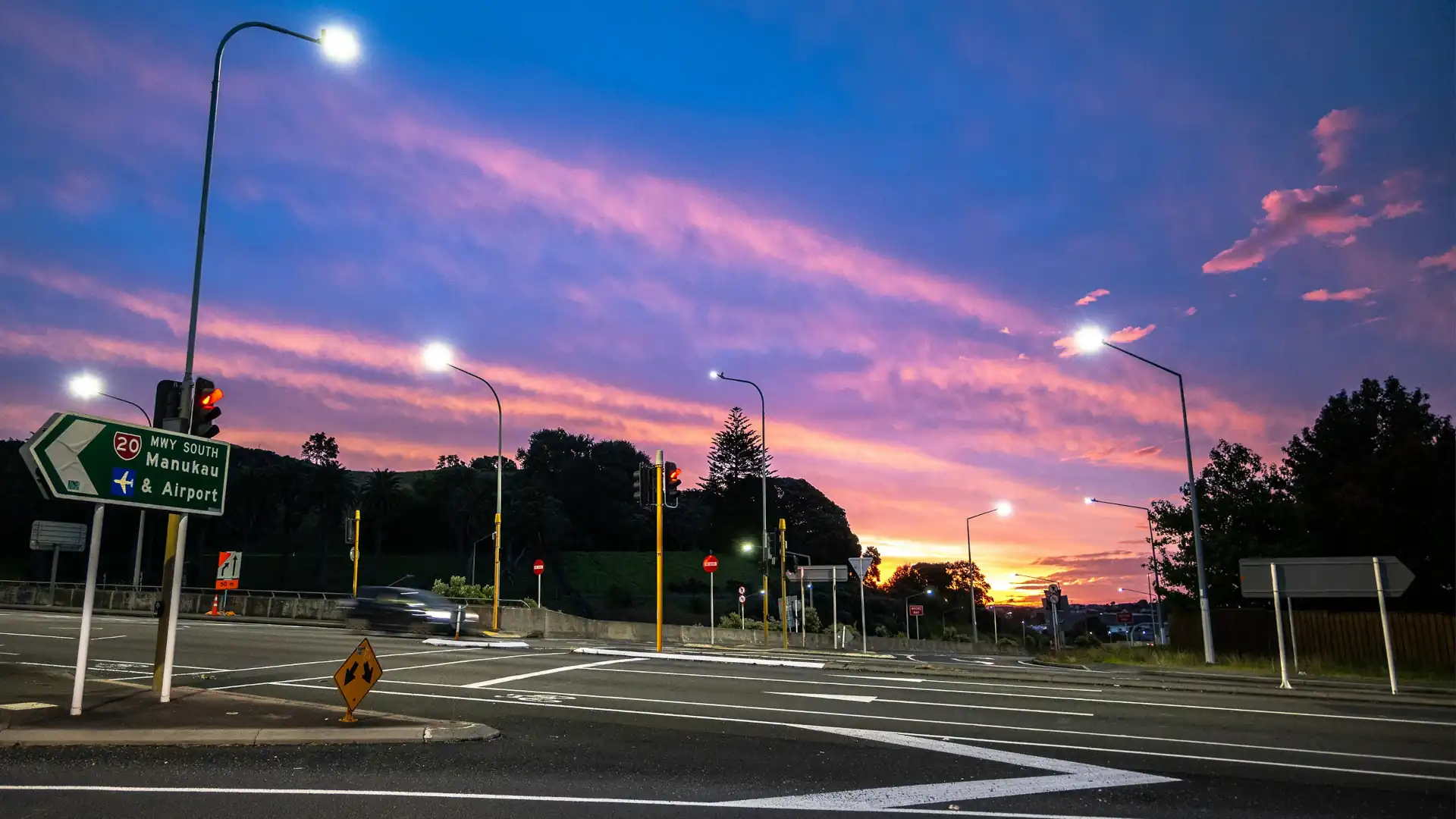
Every Auckland driver knows the moment. The light goes orange, the car in front puts its foot down, and you’ve got about a second to make the call. Thousands of drivers a year get it wrong in front of a red light camera in Auckland, and one camera has caught more of them than any other.
That’s the camera at Esmonde Road and Fred Thomas Drive in Takapuna. It issued 12,778 tickets between June 2018 and May 2025, roughly one in every seven red light camera tickets handed out in Auckland over that time.
In July 2025, NZ Police handed the country’s safety cameras to NZ Transport Agency Waka Kotahi (NZTA). That makes Police’s offence data, which runs to May 2025, the full record of the Police era. We’ve matched it against NZTA’s current camera list to map every camera and see what seven years of tickets say about red light running in Auckland.
Where Are the Red Light Cameras in Auckland?
There are 33 red light cameras across Auckland on NZTA’s list of fixed safety cameras, and South Auckland has the most.
Where Auckland's red light cameras are
The 33 red light cameras on NZTA's current list for Auckland. Circles are sized by the tickets each camera issued before NZTA took over.
Sources: NZ Police road policing driver offence data (red light camera tickets, to May 2025); NZTA fixed safety camera locations (updated 26 August 2026). NZTA has issued camera tickets since July 2025 and has not published site-level figures. Graphic: TSL. Jul 2023 – Jun 2024 is the last full year before cameras moved to NZTA. Great South Rd / Cavendish Dr combines its two cameras (NZTA lists one as Great South Rd / Te Irirangi Dr). Lambie Dr / Manukau Station Rd is matched to the Police site Lambie Dr / SH20 off-ramp. Red Beach is shown at the map edge. Coastline © OpenStreetMap contributors.
South Auckland’s 11 cameras are spread across Manukau, Ōtara, Papatoetoe and Māngere East. Central Auckland has seven, the North Shore and East Auckland six each, and West Auckland three, from Takapuna and Red Beach in the north to Te Atatū South in the west. Cameras do come and go, so NZTA’s list is the one to check for the latest.
Which Red Light Cameras Catch the Most Drivers?
Esmonde Road has caught more drivers than any other red light camera in Auckland, and it isn’t close. Between July 2017 and May 2025, it issued nearly three times as many tickets as the next camera, including 4,961 in 2019 alone. If Auckland’s intersection cameras had an employee of the month, Esmonde Road would have retired the trophy.
Auckland's most-ticketed red light cameras
Cameras on NZTA's current enforcement list, ranked by the red light tickets they issued under Police.
Sources: NZ Police road policing driver offence data (red light camera tickets, to May 2025); NZTA fixed safety camera locations (updated 26 August 2026). NZTA has issued camera tickets since July 2025 and has not published site-level figures. Graphic: TSL. Jul 2023 – Jun 2024 is the last full year before cameras moved to NZTA. Great South Rd / Cavendish Dr combines its two cameras (NZTA lists one as Great South Rd / Te Irirangi Dr). Lambie Dr / Manukau Station Rd is matched to the Police site Lambie Dr / SH20 off-ramp. Excludes sites no longer on NZTA's list.
Over the whole period, the Great South Road cameras at Cavendish Drive and Reagan Road in Manukau come second and third. Their busiest years are behind them, though. In the latest full year, July 2023 – June 2024, they issued just 188 and 158 tickets. Esmonde Road still led with 1,414, followed by the Bairds Road camera in Ōtara with 726 and Millwater Parkway in Red Beach with 559, even though it only started issuing tickets in 2021.
Why stop at June 2024? Cameras moved over to NZTA one by one during 2024/25, so later tickets are missing from the Police data. The rankings also only include cameras on NZTA’s current list.
A Few Intersections Catch Most of the Drivers
Red light running is heavily concentrated, too. Of the 44 Auckland cameras that issued Police tickets between July 2017 and May 2025, the busiest five issued 38% of all tickets. The quietest half, 22 cameras, managed just 18% between them.
Traffic volume explains some of this. Esmonde Road carries a steady stream of traffic between the Northern Motorway and Takapuna, and more cars means more chances for someone to run a red. Ticket counts don’t show how many vehicles pass through each intersection, though, so they can’t give a true rate of red light running. When a handful of intersections produce most of the offences, something about those sites is part of the problem.
East Tāmaki Road: Auckland’s Red Light Corridor
No road in Auckland has as many busy red light cameras as East Tāmaki Road. Three of the top seven cameras in 2023/24 are on it: Bairds Road, Ōtara Road, and the Great South Road intersection in Papatoetoe. Between them, they issued 1,623 tickets that year. A fourth, at Huia Road in Papatoetoe, added another 586 before it stopped issuing Police tickets in June 2024.
If there’s one stretch of Auckland road where pushing through on orange is most likely to cost you $150, this is it.
The Cameras That Have Come and Gone
Not every busy camera made NZTA’s current list. The biggest absence is the camera at Great North Road and Lincoln Road in Henderson, which issued 1,601 tickets in 2023/24, more than Esmonde Road. Its last Police-issued ticket was in March 2025. The Waterview camera on Great North Road and the Huia Road camera are also gone.
It works the other way, too. Three cameras that had stopped issuing Police tickets are back on the list: the Union Street camera in the city centre, the Te Irirangi Drive camera on Tī Rākau Drive in Golflands, and the Manukau Station Road camera on Lambie Drive, which had been quiet since August 2022. The Police data doesn’t say why cameras stop and start, so we won’t guess.
Are Aucklanders Running Fewer Red Lights?
At the intersections with cameras, yes. In 2018/19, 14 cameras issued 15,284 tickets. Three years later, 44 cameras issued almost exactly the same number. Then tickets dropped 30% in two years, to 10,633 in 2023/24.
More cameras, fewer tickets
Auckland's red light cameras tripled in number between 2018/19 and 2021/22. Since then, total tickets have fallen by 30%, and the average camera now catches about a quarter as many drivers as in 2018/19. Years run July to June.
Swipe the chart to see every year.
Sources: NZ Police road policing driver offence data (red light camera tickets, to May 2025); NZTA fixed safety camera locations (updated 26 August 2026). NZTA has issued camera tickets since July 2025 and has not published site-level figures. Graphic: TSL. 2024/25 is incomplete: tickets stop in May 2025, and cameras moved to NZTA one by one during the year, so later tickets are missing. Graphic: TSL
Over those years, the average camera went from about 1,092 tickets a year to 259. Part of that is because newer cameras went in at quieter intersections. The clearer pattern shows up when you follow each camera on its own.
Of the 41 cameras with at least three years of Police data, 38 issued fewer tickets in their third year than in their first, and the typical camera’s tickets fell by 58%. Even Esmonde Road dropped from about 320 tickets a month in its first year to about 110 in its third. That’s what you’d expect if drivers learn where the cameras are and ease off, which is exactly what publishing the locations is meant to do.
Not Every Camera Fades
A few cameras bucked the trend and got busier again. Esmonde Road rose from 1,021 tickets in 2022/23 to 1,414 in 2023/24, and the camera at the top of Ponsonby Road nearly tripled, from 195 to 542. The Henderson camera climbed from 394 to 1,601 over two years.
The Police data can’t tell us why. Changes in traffic, nearby roadworks or tweaks to signal timing could all play a part. Either way, a camera whose tickets start climbing again is a sign the intersection deserves a closer look from its road controlling authority.
Why Drivers Run Red Lights, and What Signal Design Can Do About It
Some intersections make red light running more likely than others, and the way they’re signalled is a big reason why.
The biggest factor is amber timing; the orange light, to most of us. It should give a driver travelling at the speed limit enough time to either stop comfortably or clear the line. If it’s too short for the approach speed, drivers end up in what engineers call the “dilemma zone”: too close to stop safely, too far away to get through. Smart radar detection helps by tracking approaching vehicles and extending the green for a driver who can’t stop in time. All-red clearance intervals, where every approach shows red for a moment, and well-coordinated corridors take the pressure off further.
Reviewing timing and detection at problem intersections is a core part of TSL’s traffic signals work. The Main Highway camera in Ellerslie is at an intersection that also features in our analysis of Auckland’s worst intersections .
Do Red Light Cameras Work?
The Auckland evidence says they do. A trial of red light cameras in Auckland between 2008 and 2010 found an average 43% reduction in red light running at camera sites, and a 69% average drop in the crashes it causes. At one Symonds Street intersection, the trial’s evaluation report recorded infringements falling from an average of 37 a day to eight. Today’s cameras show the same pattern.
That matters, because red light running does real damage. Between 2017 and 2021, it caused 13 deaths and 95 serious injury crashes in Auckland.
If You Get a Red Light Camera Notice
- The fine is $150, and camera notices don’t carry demerit points.
- NZTA sends the notices now, not the Police.
- You can request the photo and video recorded against your notice.
- If you weren’t driving, tell NZTA before you pay. Paying means accepting responsibility for the offence.
Red light cameras are separate from Auckland’s other traffic cameras, like fixed speed cameras. You’ll find both on NZTA’s camera list.
What Seven Years of Red Light Camera Data Tells Us
Cameras work where they’re placed. Almost every Auckland camera issued fewer tickets as it got older, often far fewer, which is what the 2008–2010 trial found too.
The problem is also concentrated. Esmonde Road and the East Tāmaki Road corridor account for a big share of Auckland’s red light offences, which makes this as much an intersection problem as a driver one. Intersection problems can be designed out.
What we can’t see yet is the crash side. Tickets tell us how people drive, but crashes tell us whether they’re safer. With NZTA now running the network, publishing ticket and crash data together, site by site, would show which cameras are doing their job and which intersections need more than a camera.
And the best red light camera is still the one that never has to take your photo.
Planning works on a signalised intersection or corridor? Talk to our traffic signals team.